After the Project Budget Lecture, Sharna, Natasza and I were told by Bernardo to meet up and discuss our tasks together. During the meeting, I proposed that we begin by deciding the puzzles as they would shape the narrative and environment design.
Firstly, I explained the results from my previous discussion about puzzles to Sharna and Natasza. The results are listed below.
Results from previous discussion on puzzles:
Have five main quests – these are either necessary to complete the level or important to the game
Have additional smaller quests that are optional – these will provide narrative and give the player incentive to explore the environment – these will increase immersion
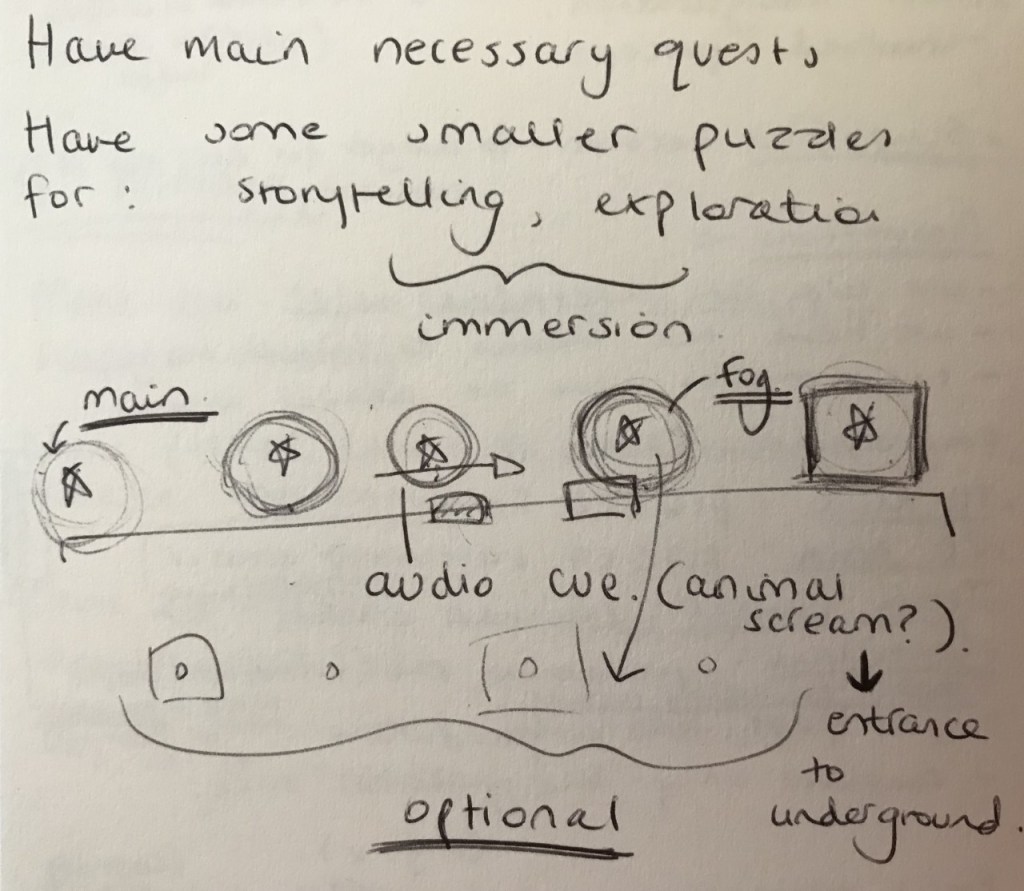
To begin with, I drew a quick diagram to demonstrate the order the quests should appear in. The diagram is shown below.
Next, I explained that these were the main quests so far:
Flies Quest:
The frog asks you to get it some flies so that it can help you reach the highest ledge – this is the entrance to the next level
The player must find the spider and talk to it – it will ask for a flower from the sakura tree it resides on – it is too scared to leave its web
The player must ram the tree and a sakura will fall onto the web whilst another sakura falls to the ground – the player can pick this up to use in another quest
The spider gives the player some flies
The player returns to the frog to give it the flies
Hidden Area Quest (optional):
There are fallen trees off to the side of the path
The deer can eat the bark to find a burrow underneath
They can enter the burrow to discover an area beneath the path
In the area is a turtle shell
The player can pick the turtle shell up – this will unlock the option to kill the frog if used as a stepping stone to reach the frog or it can be used in another quest
Snake Quest:
Snake is blocking the path – prevents player from progressing – the tiger destroyed its home so it is sleeping here
A skunk is hiding nearby due to the tiger chasing it (can show this through footprints) – the player must scare the skunk so that its smell can lure the snake away from the path
The player must go to the waterfall and enter the water so that they’re covered in seaweed – this makes the deer look mutated – like they have stripes – similar to the tiger
The player must then bark at the skunk – this scares the skunk and the snake is lured away – the skunk sees the deer and is reminded of the tiger – the player can now progress
Plant Quest:
The frog will pretend to think that the player meant the lower ledge after it gets the flies – it will then ask the player to fetch it an item – a special, one-of-a-kind flower
The player must travel to the mountains – there they will see the flower on the side of a mountain – it is unreachable
The player must then combine the sakura they have with other items in order to replicate that flower to fool the frog
The player will then return to the frog and give it the fake flower
The frog helps the player reach the highest ledge and the player gains the frog as a friend – the player moves onto the next level
To start with, I suggested that we come up with a fifth main quest and complete the details for how the plant quest should be accomplished.
The Fifth Main Quest
We decided that it was best for the fifth main quest to diverge from the other main quests in terms of game options – we already had quests involving animals, obstacles and fetching – we wanted something a bit different for the fifth main quest. During this discussion, we began talking about the environment layout and how the player could access the underground area. We theorised about making the entrance known to the player through an audio cue – when the player walks over the entrance, an animal’s whimper would play. The player would then just need to interact with the area to find it. However, this was dismissed as being too simple.
As an alternative, we discussed making the underground entrance another hidden area but we wished to make it differentiate from the hidden area quest. As a result, we decided to make it a part of the fifth main quest. We also talked about what the entrance would look like as I didn’t want it to just be another hole like the burrow. In the end, we chose to make the entrance a large plant that, when stepped on, will tilt into a slide that takes the player to the underground area.
In order to make the entrance to the underworld hidden, we chose to use the weather instead of a physical obstacle. The concept of using fog was picked as a good method of masking the entrance. To get rid of the fog, the player would need an item of some sort. We decided upon a special wind plant that blows wind – since a lot of the main quests involve animals, we chose to use a plant instead.
Then came the issue with how the plant is obtained. I suggested that it be a withering, famished plant that requires sustenance in order to follow the player – it would be a sentient, walking plant. Berries were chosen as the food item the plant needs – they would be found on a bush. The player would then need the plant to follow them – we decided upon the concept of using sound – the plant would be blind. The player would need to hit objects for it to follow them. However, this meant that a mechanic that allows for this would need to be implemented into the game and we would need to decide what objects can be hit. As an alternative, we decided that the player could just use the bark function to lure the plant.
Next, we needed to solve the issue of how the player could command the plant to blow wind. I proposed that we just have the wind plant blow continuously or periodically after it is fed and rejuvenated. This way, there would be no need to worry about possibly requiring additional mechanics.

Completing the Plant Quest
The details that needed completing were the items required for making the sakura into the special flower. We decided that two items was a good number for making it complex enough to be engaging without making the quest too convoluted. We wished for the two items to do different things to the sakura to make the quest more interesting – this meant that two different things needed to be changed on the sakura. In the end, we chose colour and shape as the things that needed changing.
As a rough idea, I made the special flower a purple flower with three petals and spikes protruding out from the areas between the petals.
This meant that the sakura needed:
One petal removed – when the deer interacts with the flower, it will bite a petal off
To be turned purple
Three spikes attached
Whilst the first change could be accomplished simply, the other two changes required items of some sort.
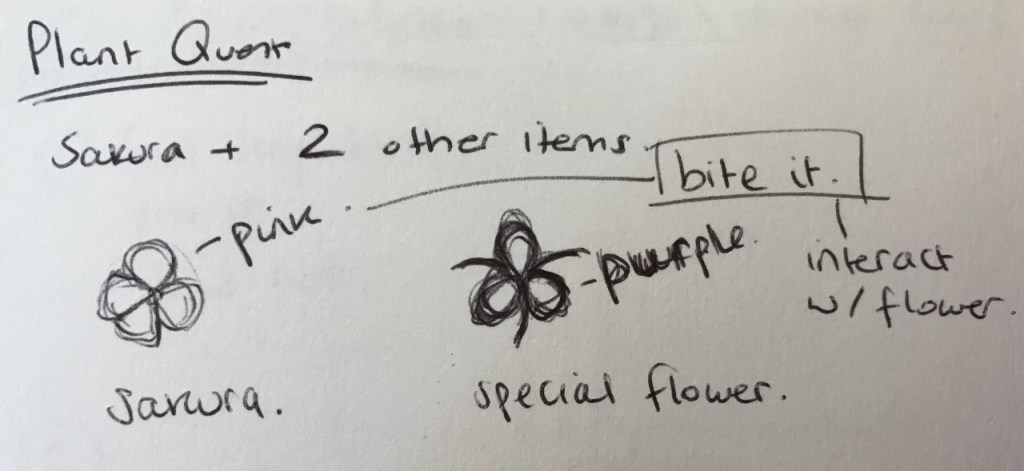
Turning purple – to turn the pink sakura purple, we needed a blue substance. Two ideas were proposed for this dilemma – a blue food or blue saliva/spit. The latter was chosen as it was more interesting and allowed for a more unique quest. Next, we needed a creature or plant that spits blue saliva. The idea of a swamp creature that is never fully seen came up as a possibility. It could spit whenever the player walks by – the player wouldn’t know why until this mission is activated. The player would need to place the flower by the swamp and walk past to trigger the spitting.
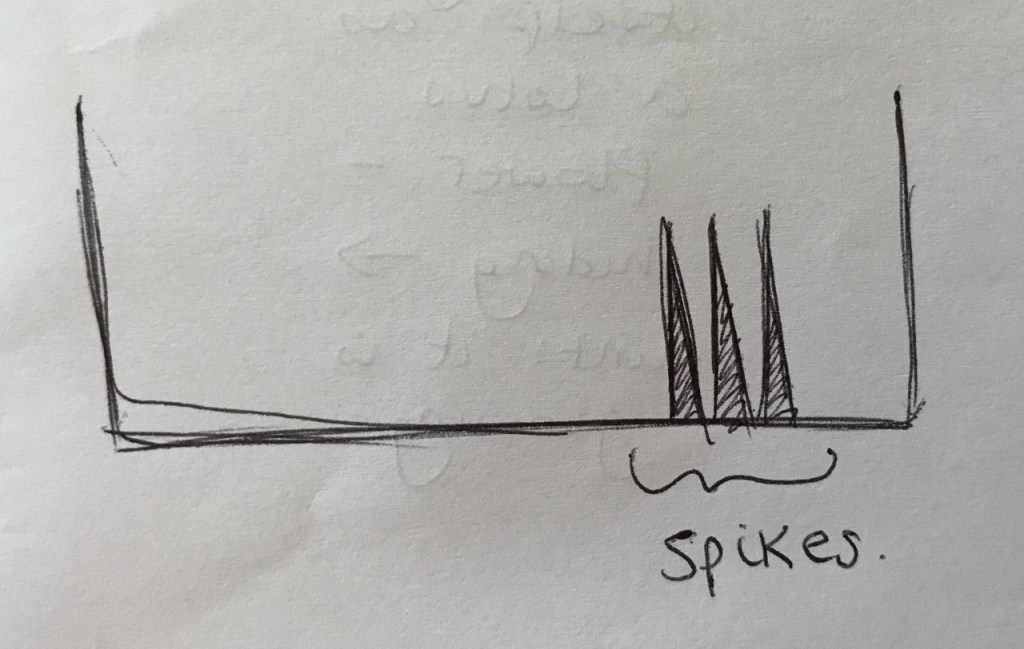
Getting three spikes – we decided to make the spikes be underground as not many of the quests so far require the player to travel underground. I proposed that the spikes be protruding from the ground – when the player is in the midst of taking one, the area will begin to crumble and break – the deer will then automatically place the spike back and let go. The player would need to replace the spikes with something else – these items need to be of a similar shape. We discussed ideas for what the items could be and ended up choosing to use sticks. However, we wanted the sticks to be harder to find than just picking them off of the ground or ramming a tree. As a result, we chose to use eroded sticks from the waterfall. Normal sticks would be found near the spikes to act as red herrings.
The Four Smaller Optional Quests
Next, we discussed how many smaller quests there should be and what one would obtain from doing them. We decided upon having four smaller quests as it would make the total amount of quests nine – enough to make the gameplay feel saturated without overloading the game with quests. Written below are the details for how the four smaller quests came to be and what they are. In regards to what the player gains from completing these quests, we discussed making the rewards non-materialistic as the main quests already offered many items. We couldn’t make the optional quests give items that were necessary to the level’s completion so it didn’t seem to make much sense to offer players items that had little importance. In the end, we made the smaller quests offer elements of narrative whilst the end rewards would range from visual sequences to musical tunes.
Bird Quest
We decided that the smaller quests should be simple but engaging enough to entice players. They should also differ from the main quests in terms of tasks. For the first one, we wanted to include a quest that involved the player helping background animals in order to get them attached to the world and its inhabitants – this would also serve as a deterrent for killing the frog.
In the end, a baby bird was chosen as the helpless animal as the deer could gain it as a temporary companion by having the bird on its back. In order to keep things simple, we made the quest merely consist of bringing the baby bird back to its mother.
Rhino Quest
Next, we decided to make a puzzle that offered a non-visual reward for a sense of variety. The notion of offering the player a reward in the form of music was suggested – this concept appealed to us as it would create another layer of beauty within the game to accompany the visuals. Thus, we began brainstorming ways of incorporating such a notion into a puzzle. We ended up deciding to have special plants that could be used as musical instruments if hit/headbutted.
Firstly, we needed to decide on a reason for why the player would need to make music. I suggested that an animal could be trying to play a song for the funeral of a dear friend – a bird. The song could be a homage to the late bird’s favourite tune. The animal could require the deer’s help because it keeps accidentally destroying the special plants by headbutting them too harshly.
This meant that the animal needed to be one known for their strength or strong head – as a placeholder, we chose a rhino. The player would merely show the rhino how to gently headbutt the plants through demonstration – the player has to play the tune correctly (the tune will be occasionally played throughout the game). Then, a musical sequence will ensue.
Crystal Cave Quest
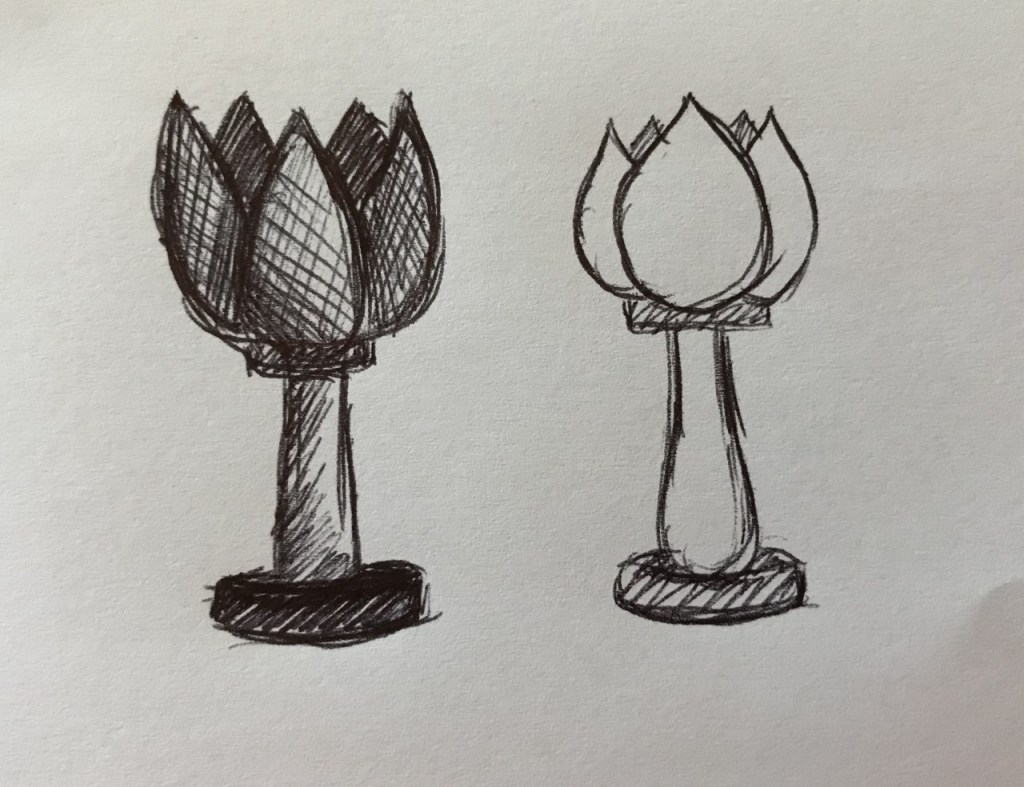
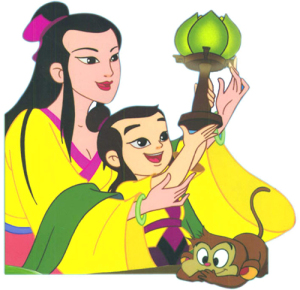
After some discussion, we decided to opt for a quest that offered the player aesthetically pleasing visuals as a reward. I suggested that we have a quest that lights up dim crystals, which would lead to a beautiful animation of the crystals reclaiming their glow. I also suggested that we have a lotus lantern (inspired by the movie ‘Lotus Lantern’) as the item that would light up the crystals – the lantern would contain glow flies.
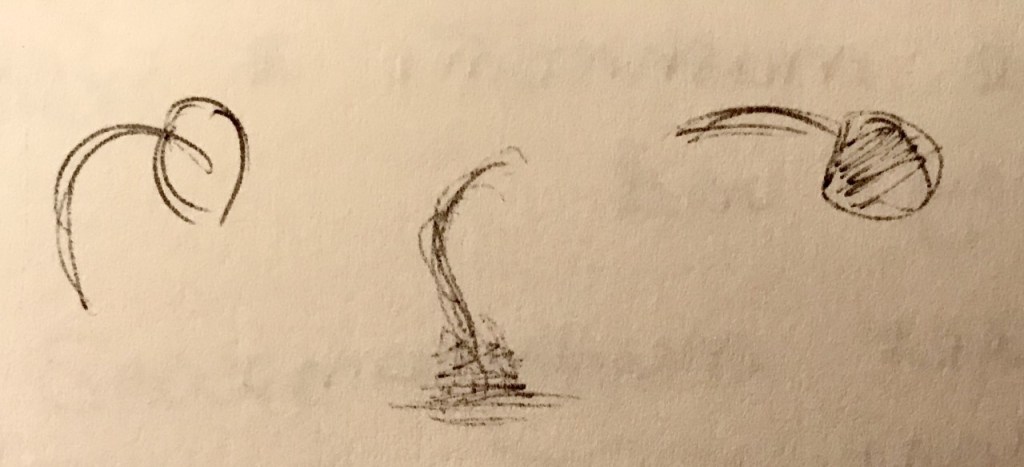
Shown below is are two sketches of the lotus lantern – the first one was drawn without a reference whilst the second one was drawn using the image beside it as a reference. The image is from the movie ‘Lotus Lantern’, which features a lotus-shaped lantern that glows using glowflies as its source of light.
We wanted this quest to be very simple so it merely consists of the player discovering the cave, finding the lotus lantern and placing it in the cave.
Mushroom Quest
Finally, we wanted a quest that differed from the rest and ended up deciding to create a passive quest that the player could gradually complete throughout the game. We chose to make the quest a ‘collecting quest’, where six special mushrooms will be hidden throughout the game for the player to obtain. These can be planted into the empty plot of land that lies underground – this will eventually become a mushroom farm that feeds smaller animals. We then had to decide on the amount of mushrooms the player had to replant to complete the quest. We wanted it to be a number large enough to make the quest be a passive one the player could slowly complete throughout the game, but not so large that it made the quest hard to complete. We finally decided on 6 mushrooms.
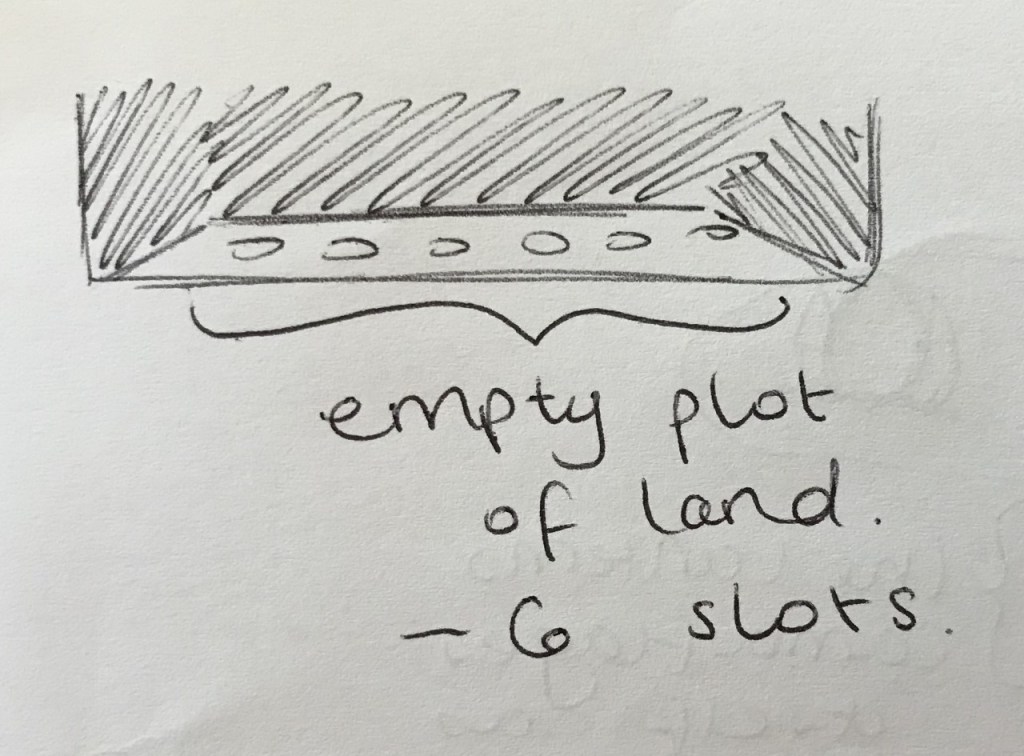
However, we needed a reason behind the mushroom farm’s creation. After some discussion, we decided that there exists a mushroom farm above ground that has been taken over by mutated carnivores – they have mutated to desire mushrooms. This meant that smaller animals were devoid of a food source. The player can then create a new mushroom farm for them underground, where the entrance is small enough to prevent the mutated carnivores from entering.
We struggled to come up with a sufficient reward for such a quest but eventually opted to keep it simple – as the mushrooms are planted, small animals will flock to the farm. When all the mushrooms are planted, there will be an animation of various small animals enjoying the mushrooms happily.
 Eden: A Muntjac's Tale
Leave a comment