Before creating our project budget, we were told to assume that:
We are an independent studio
We have the means to publish our game – do not consider the costs for publishing the game – consider only the costs for the development of the game
We have basic hardware – e.g. PCs
All teammates have an annual income
We were also told to consider only the costs for making the vertical slice – not the whole game.
Making the Project Budget (version one)
We took into consideration each team member’s wages, which were calculated by hour per week and multiplied by 14 to get the total wages for the project’s duration.
Additionally, we also considered software and equipment we would need to use for this project. We decided to include the cost of Clip Studio Paint Pro multiplied by the amount of artists in this project (4) Clip Studio Paint Pro was chosen as the more expensive EX version mainly offered benefits for animators. It was also the one art program most of us had/used.
In regards to equipment, we decided to include graphics tablets for the artists. We chose the Cintiq as it was industry standard.
Shown below is the project budget for our vertical slice.

Risk Mitigation: (7-12% of the total production costs)
£2413.72 to £4137.81
Profit: (multiply budget by the % you need the project to return & divide the value by the number of units you think the game will sell)
We were told that a survey would be given out during the arcade in which our vertical slices would be played by visitors. Each person who says they would buy our game will represent 100 sales. After some discussion as a team, we estimated that 30 people would say they would buy our game – this meant we estimated that our game would generate 3000 sales.
We researched for similar games to our’s on Steam to see how they were priced on average. We searched for click-and-point games – they ranged from £10-£15 on average. We decided that since we were only making a vertical slice, we would price at the lower price of £11. This meant that we had estimated that we would sell 3000 lots of £11, which equated to a total of £33,000 in sales.
We also decided that the % of the budget we wanted the project to return had to be enough to fund another game project – we were advised to not make this % too high to ensure we are not too idealistic. We were told to keep this % between 10-15%. We chose to use 12%.
£34,481.74 x 12 = £413,780.88
£413,780.88 divided by 3000 = £137.93
Making the Project Budget (version two)
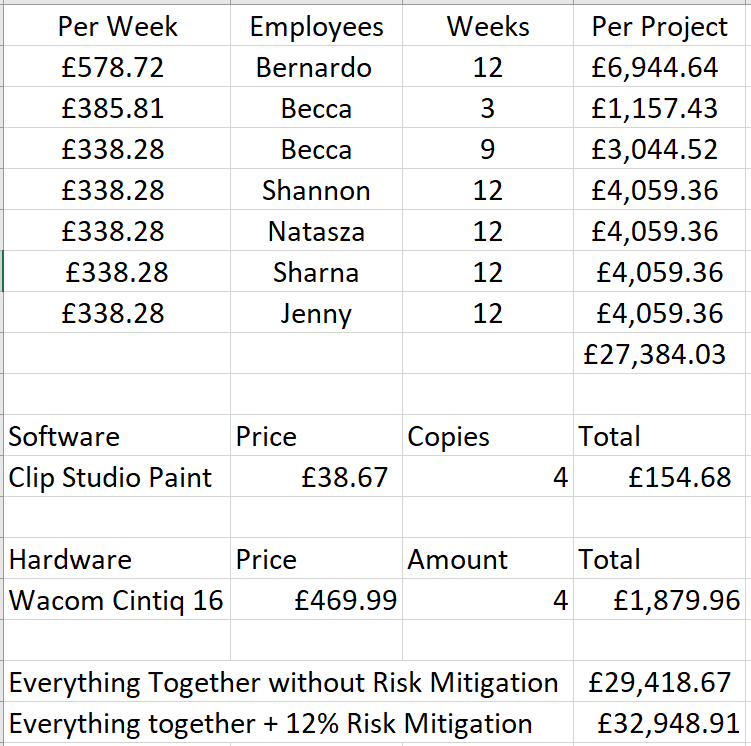
After deciding the amount of time each game element would need to be completed and assigning roles to all team members, we created a new project budget. In this new budget, we changed the amount of weeks each member should be paid for according to the amount of time they needed to complete their assigned work.
Profit: (multiply budget by the % you need the project to return & divide the value by the number of units you think the game will sell)
This time, we decided that the amount of profit we would need the project to return should be the production cost amount itself. This meant that we would need to make back the budget costs in the game’s sales. This made the % we wanted the project to return be 200%.
£32,948.91 x 200 = £6,589,782
£6,589,782 divided by 3000 = £2196.59
 Eden: A Muntjac's Tale
Leave a comment