Eden’s GDD Blog: https://aliceuniblog.wordpress.com/
Overview
Genre: a single-player 2D side-scrolling Adventure Platformer
However, the GDD does not specify any requirements for platformer level designs aside from examples of obstacles at ground level.
Perhaps, it would be best to disregard the platformer aspect of the game and make movement be across even ground and up/down interactive items as I believe that it is not essential for the game to retain its status as a platformer – the game is art, story and characters-based as opposed to mechanics-based so it wouldn’t make sense for it to be so movement-based.
Target Audience/Rating: 17+/M
This means that the game will consist of heavy violence/gore.
Essential Experience: Overcoming paranoia & Realising one’s own self-worth, even if it means going against one’s own nature to do so
The latter can be accounted for as the game gives the option for the herbivore muntjac deer to become carnivorous – this goes against the deer’s nature. However, how can this help one realise their own self-worth? Is this achieved through the mutations helping the deer scare away the tiger?
The former is accounted for through the deer having the courage to face the tiger in the end – but is this too subtle? This can be fixed by having the presence of the tiger be a constant throughout the game – this can be achieved through the use of visuals and sound design. E.g. the shadow of the tiger can be seen moving in the background or the sound of its roar can be heard in the distance.
Design Goals:
Create an immersive with interesting and charming characters
Spread awareness about endangered rainforest animals
Both design goals seem to be narrative-based with the latter also depending on visual design. The latter is not explicitly mentioned in any other part of the GDD so ways in which it could be achieved are not specified. This issue can be fixed by using the dialogue and environmental storytelling to imply deforestation and/or extinction. E.g. the tiger’s usual prey died off and so it murdered the deer family as a food alternative and/or the animal mutations are a result of humans contaminating the forest.
Overview: A point-and-click game with dialogue options. The player controls a muntjac deer that travels through a 2D side-scrolling world to interact with NPCs and complete tasks
The point-and-click aspect of the game contradicts its platformer genre. The controls for movement suggest the latter but the controls for interaction suggest the former. It would be more logical and concise to choose one genre over the other as the varying genres require different mechanics. Furthermore, each genre also infers different methods of level design. A point-and-click genre implies a more puzzle and narrative-based level design whilst a platformer insinuates a more movement-based level design.
Gameplay: Play as a helpless creature and develop strength & character to achieve goals
The concept of developing character to achieve goals seems to be unnecessary as it does not affect gameplay. However, this issue could be resolved by making the deer’s character affect their dialogue options.
Is there more than one way to develop strength? Is mutation the only way? What if the player chooses the normal route? Will they be able to achieve their goals or the game’s essential experiences?
Final Goal: Chase tiger away
How is this achieved? Does the player use the deer’s appearance as a tool for scaring the tiger away? Is there a fight or a conversation? Can the player achieve this on the normal route? Are there different endings depending on the player’s choices in the game?
For Any Platform
The game’s inclusion of a cursor and the controls imply that it is made for the PC but due to its short list of mechanics – walk forward, walk backwards, jump, crouch – it can easily be optimised for consoles.
Game References:
For Gameplay – Oxenfree
For Visuals – Ori and the Blind Forest
The GDD doesn’t specify what certain aspects we should look at. I assume that it is the dialogue mechanic from Oxenfree and environments from Ori that are used as references.
Story
Narrative: The Muntjac Deer just lost its family to a new predator – the tiger
This means that the tiger either had just moved to the rainforest or has never been encountered by the deer before. The GDD does not go into detail about the tiger’s backstory or motives.
Opening Cut Scene: Interactive cut scene that partially serves as a tutorial for the player so that they can become familiar with the controls – the player must hover the cursor over certain elements in the scenes to interact with them
This could be an effective way of integrating a tutorial into a game without it boring the player or halting gameplay.
Opening Cut Scene Events:
1. Happy muntjac deer family is shown – establishes a positive atmosphere so that the negative events that follow have a bigger impact
2. Player clicks on butterfly & muntjac deer turns around to follow butterfly – this gives a reason for the deer being separated from the family
3. Muntjac deer hears noise and goes back towards family – the GDD does not specify what the noise is. I assume that it is either the tiger’s roar, the deer family’s cries or both.
4. Player clicks on bush and muntjac deer hides in there – The GDD does not explain the deer’s incentive to hide after running towards its family. I assume that it is because it saw the tiger. Having the deer hide nearby is a good excuse for making the deer to witness the tiger and its dead family. It helps provide character motivation.
5. Black screen – is this necessary? It could help build up tension but this can be achieved in other ways. A black screen is not contextually needed – the deer’s eyes are not closed and a bush does not obscure light to that extent. Perhaps this scene should be replaced with a dimly lit shot of the deer.
6. Tiger’s legs are shown – this is a good method of showcasing the size of the tiger in comparison to the deer. However, the tiger could be shown in other methods as well, e.g. its eyes, its roar, etc. Is this the most effective method?
7. Shows muntjac deer looking out from the bush – should this shot be shown earlier so as to not break the sequential shots of the tiger? It may break tension.
8. Deer carcasses are shown on the ground whilst blood drips from tiger – this is a good method of inferring that the tiger murdered the deer’s family without directly showing their deaths.
Gameplay
Mechanics/Controls:
D to Walk Forwards
A to Walk Backwards
Space to Jump
S to Crouch
It seems unnecessary to have the player use a cursor when all movement is controlled using the keyboard. Perhaps changing the hovering the cursor to reveal options to walk near items/animals to reveal options and choose options with arrow keys would make for a better gaming experience.
Routes:
Normal Route – The player befriends animals by completing tasks for them. As a result, the player will gain them as followers that help with game progression
This gives players incentive to be kind to animals as opposed to killing them to mutate. However, what is the incentive to kill them? Perhaps it lessens gameplay time as it is easier to gain abilities by eating them than completing tasks for them. Maybe it is also easier to complete tasks if the player mutates and/or more areas will be accessible if the player mutates.
Genocide Route – The player kills and eats the animals they encounter. The deer will mutate as a result, absorbing both the animal’s characteristics and abilities. This helps the player progress further through the game
Can the player still progress if they do not mutate? Does the player have to choose between two routes? Does the player enter the genocide route once they kill or do they have to kill a certain amount of animals before they enter the genocide route? The GDD does not specify any of this. Neither does it specify how the deer absorbs the animals’ characteristics – does this show through the deer’s physical appearance or through their dialogue? Does characteristics refer to one’s personality, appearance or both? How does this affect gameplay? It could influence dialogue options.
Toucan – double jump – this is not necessary if the platformer aspect is disregarded. It also does not make sense contextually as toucans are not known for their large jumps. Does this affect the deer’s physical appearance?
Frog – use the tongue as an arm – can be used to swing up to high areas
Anteater – longer tongue – can reach further – this achieves the same result as the frog’s ability – it is too similar and therefore unnecessary
Binturong – jump further – this achieves a similar result to the toucan’s ability – it is also unnecessary as a result. It also does not make sense contextually as bears are not known for their wide leaps.
Environment Interactions:
Approach item
Hover cursor over item
Choose an option
Animal Interactions:
Approach animal
Hover cursor over animal
Choose an option
Simple mechanics – this supports the goal of making the game focus more on story, art and characters than mechanics. It also achieves the intention of making the UI simple and minimalistic.
Mutations: after killing an NPC, the player can choose to eat them to mutate and gain their characteristic & abilities
What is the incentive to not eat an animal you’ve killed? The GDD also does not specify what the different mutations will look like.
Visuals
UI:
Simple and minimalistic
Opacity of menu is 45%
Characters:
Muntjac Deer: Main/Playable Character
Appearance: Brown fur, has horns and fangs, has three blue dots on its bottom
Character: N/A
The horns suggest that is a male deer/buck. Its fangs help with eating prey. The significance of the blue dots is not explained. There is also no description for its personality.
Tiger: Antagonist
Appearance: large in comparison to deer, orange, striped (akin to a real tiger)
Character: N/A
Its appearance suggests that it has not mutated like the other animals. This may be due to it possibly being new to the rainforest or perhaps its abnormally large size is a sign of mutation. There is also no personality description for the tiger, which makes it difficult to guess its backstory and motivations – all of which are not stated in the GDD.
Toco Toucan: First NPC – partially serves as a tutorial for animal interaction and quest completion
Appearance: blue feathers, yellow beak, 3 light blue feather on head, lizard tail
Character: Loud – mimics a parrot – mocks the player
Quest: Find and break a coconut
Its character could serve as an incentive for the deer to kill it – this still leaves the deer’s motivation for eating it unknown. Does its status as a tutorial prevent the player from killing it early on? From when is the option available? Since the game is very dialogue-heavy, it should fairly late on that the option is available – but it should be available prior to completing the quest.
Its character description is very brief and there is no further description on its personality or history.
There is also no description for how it could assist the player if they are befriended.
Binturong: NPC
Appearance: cat face, bear body, blue fur, white whiskers, prehensile tail
Character: Lazy but playful
Quest: Go to tiny pond and collect 5 fish
Its character is also very brief and there is still no explanation for how it could assist the player if they are befriended.
Giant Anteater:
Appearance: Long tail, elongated skull, brown fur, blue line through body
Character: Friendly and slow
Quest: It is stuck – free him
Its character is too brief and there is no description for how it could assist the player if they are befriended. The significance of the blue line is unexplained.
Poison Dart Frog:
Appearance: Small. slimy, blue with black dots
Character: N/A
Quest: Collect and transport small frog eggs
There is no character description provided for this animal. Its physical appearance does not seem to differ much from a normal frog except for its fly-like eyes. This mutation may be too subtle to be noticed.
Environment: a rainforest with four different levels
Ground level
Tree level
Swamp Level
Tropical Level
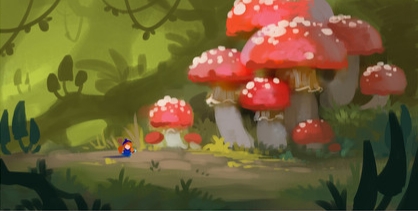
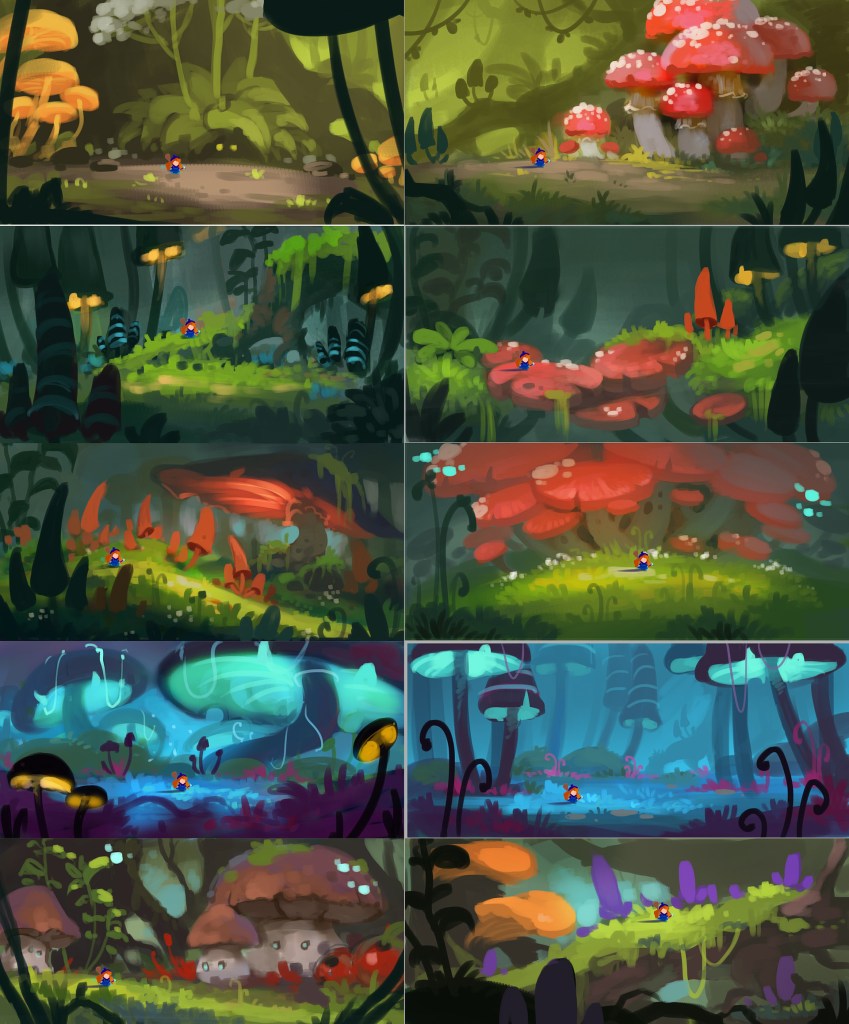
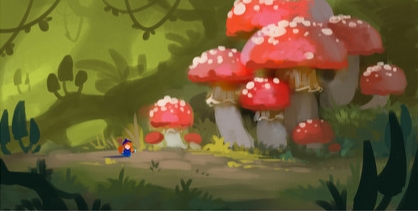
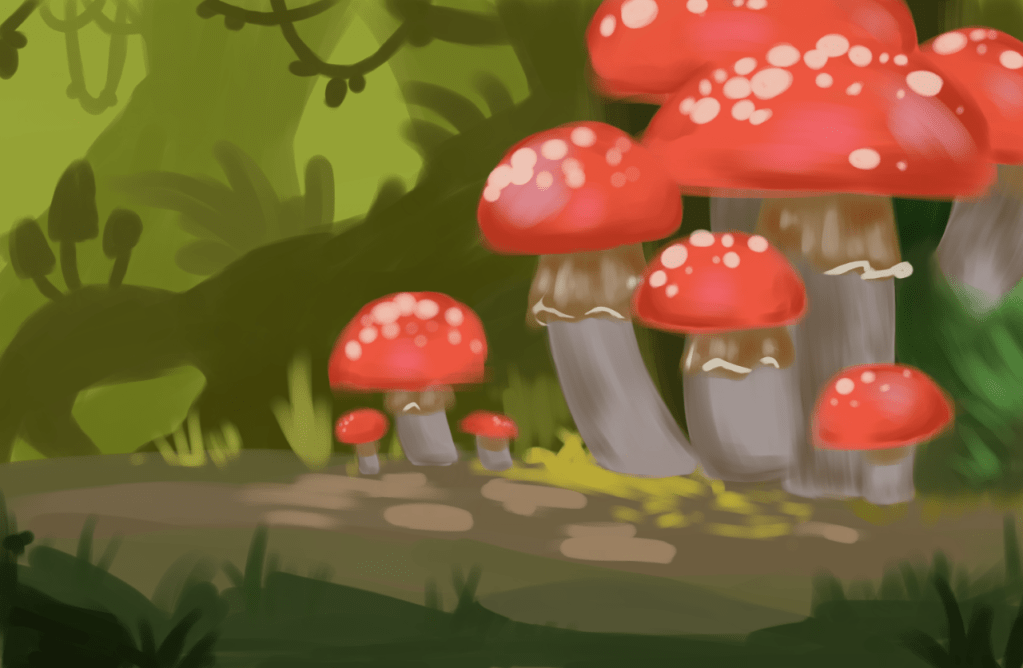
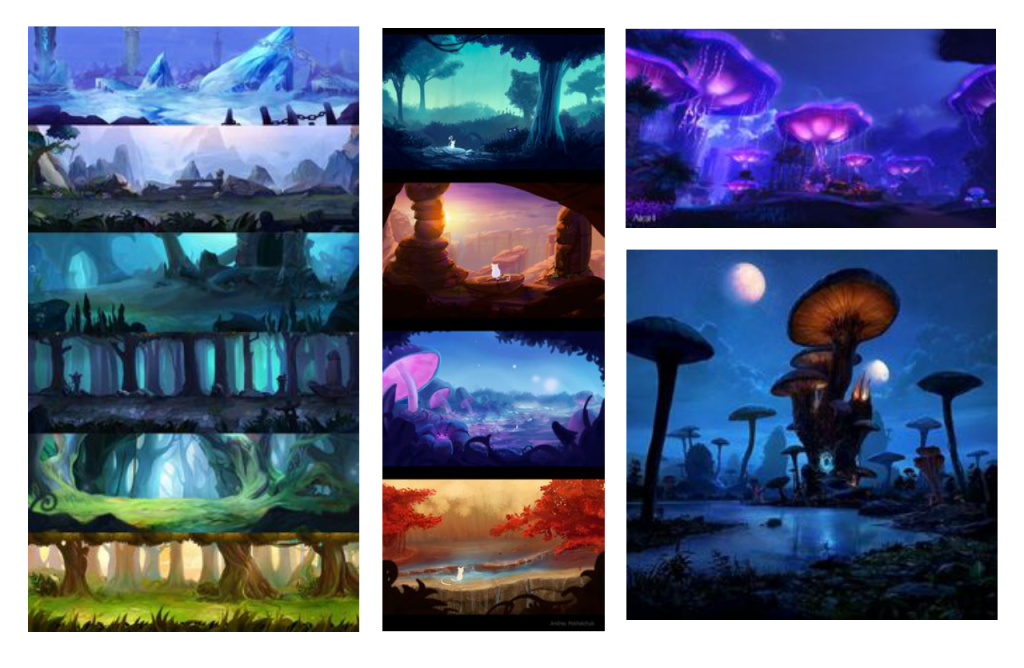
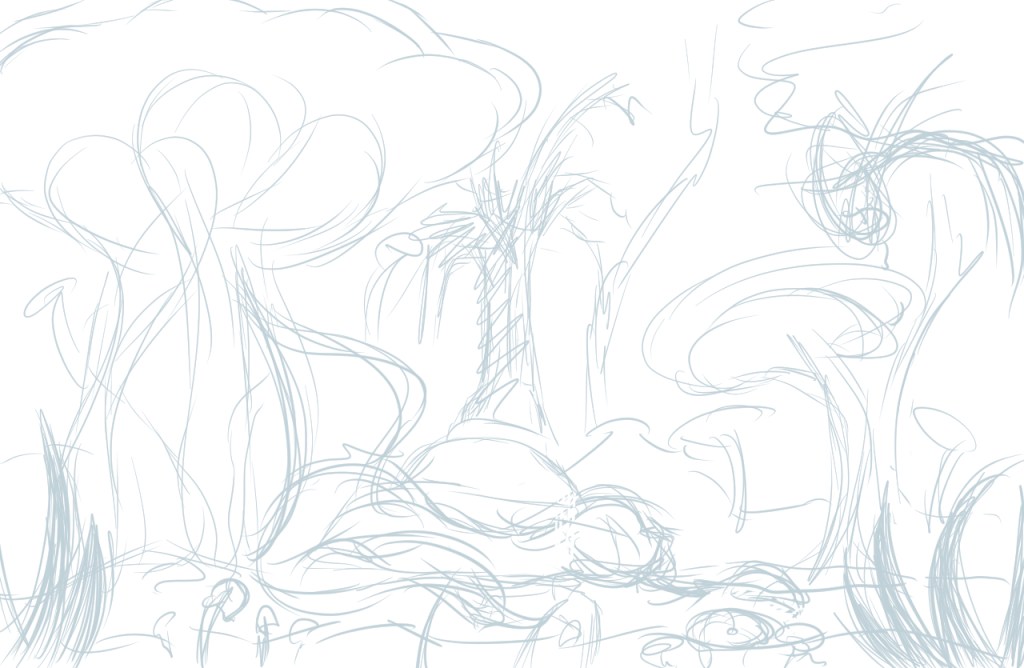
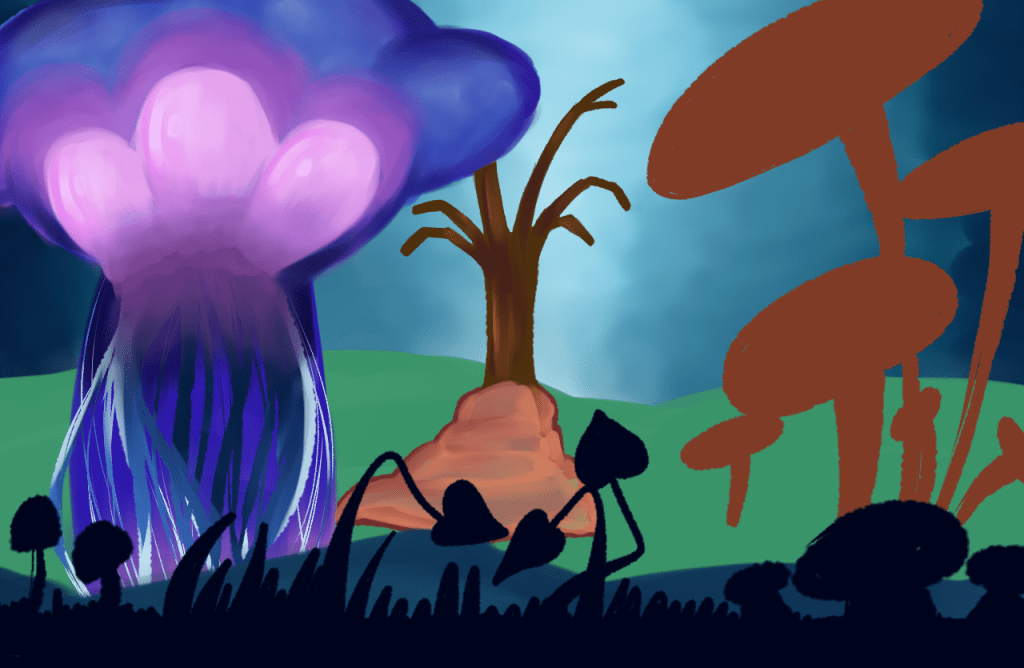
The GDD does not provide labelled examples for all of the levels. Neither does it specify which animal can be found in each one. Instead, there is a moodboard to show the game’s art style as well as an example of a tree level.
The environment moodboard provided mostly consists of Anna Lepeshkina’s concept art from her ‘personal project’: https://www.artstation.com/artwork/rg5Rm
Art Bible
Program: Manga Studio/Clip Studio Paint
Brushes: A combination of watercolour brushes and marker brushes – this is not very specific
Highlights are made using an extra layer with the ‘add glow’ setting




 Eden: A Muntjac's Tale